Showing posts with label cell phone evidence. Show all posts

Thursday, June 26, 2014

WILL LAW ENFORCEMENT OFFICERS ABIDE BY THE NEW SUPREME COURT CELL PHONE SEARCH REQUIREMENTS

Will the Supreme Court's recent cell phone search decision really protect cell phone users from improper police searches? The good news is that the Supreme Court threw out the red hearing of officer safety which law enforcement often use as an excuse in warrantless searches. 

In the vast majority of cases a cell phone can not jeopardize officer safety. Yet cowardly courts would buy into the facetious arguments of prosecutors. Chief Justice Roberts noted the distinction between checking a cell phone to be certain there's not a dangerous razor blade hidden within as opposed to roaming thru the contents of a phone to randomly find unlawful acts. 


Justice Roberts not only protected his cell phone from improper police searches but protect ever cell phone in Tampa Bay, Florida and the United States from government intrusion.
Justice Roberts' cell phone is safe
Further, Roberts noted that the potential for destroying incriminating evidence by remote wiping of the phone was unlikely and something that the officers could stop by simply taking out the phone battery or by slipping the phone in an aluminum case. For too many years judges have given law enforcement officers the benefit of the doubt in new technology even when logic, if not common sense, was strained.

Although the decision requires a search warrant to search the phone of a defendant for cell phone evidence Robert's left some leeway in a "now or never" situation and even then a worst case scenario would merely be that the evidence might not be useable to gain a conviction at trial. Roberts further noted that the cell phone of today are much more than phones with the capacity to show much more of a person's life, frame of mind, political standing and common interests.

In Florida the law has been settled for some time and at least one Tampa Bay, Florida judge had the courage to no longer allow officers to search based on a lie under oath. Last year the Florida Supreme Court made a similar decision to restrict warrantless cell phone searches when it threw out evidence gleaned from a cell phone in a robbery case. It's good that the United States Supreme Court has now settled the issue of personal privacy rights in favor of citizens as a decision for law enforcement would have reduced the privacy of every American.

Monday, November 26, 2012

COURTS IN DISARRAY ON CELL PHONE PRIVACY AS NEW DOCUMENTS SHOW LARGE INCREASE IN GOVERNMENT ELECTRONIC SURVEILLANCE OF AMERICANS

If someone is suspected of a DUI should the officer be allowed to search the person's cell phone for pornography without a warrant? If someone is suspected of grand theft should an officer be allowed to use the cell phone to help determine where the person may have been at the time of the crime? Should cell phone conversations be considered private? Is carrying a cell phone the same as carrying a briefcase? American Courts disagree even as Clearwater Criminal Defense Attorneys urge Courts to find that Americans have a reasonable expectation of privacy rights in their cell phone use.


Recent press reports note that Courts across America are greatly divided as to whether search warrants are necessary for law enforcement to use the vast amount of personal cell phone information as well as internet use and email. Not only are American Courts divided, but more troubling is the fact that even the rationals of the various Courts in making privacy rights decisions in criminal cases are inconsistent. 

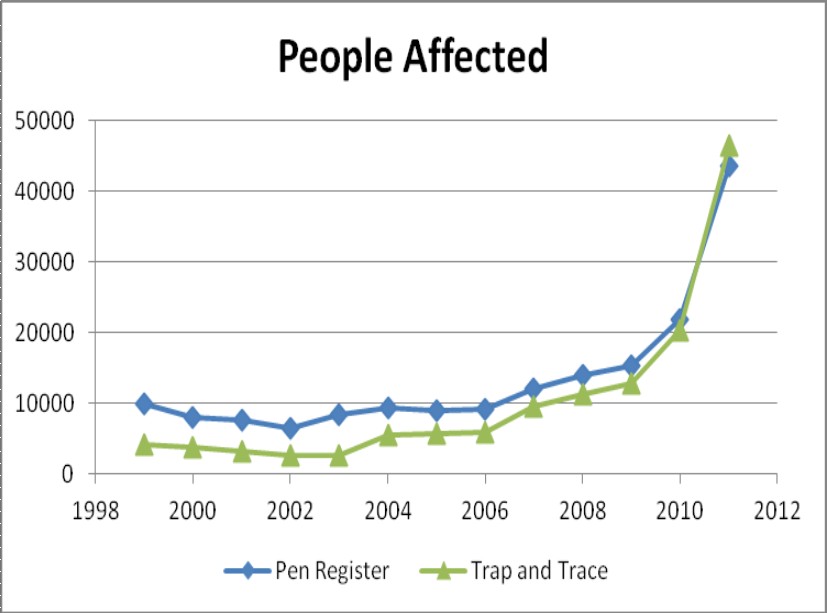
Yet as the ACLU chart below indicates an ever larger number of Americans are being subjected to phone taps, traps and traces. 
The government is using more phone taps traps and traces on Americans without getting search warrants.
Increase in Phone Taps, Traps & Traces

The failure of our Courts to agree on an overall reasonable privacy right requiring search warrants for personal cell phone information would seem to necessitate a review of privacy rights by the Supreme Court. Yet except for a recent Florida GPS case in which the Supreme Court demanded that Florida law enforcement stop using GPS to track the movement of Florida citizens, the Court has turned a blind eye to the most important privacy rights issues of this generation.
In a few days Congress will begin debates over amendments to the 1986 Electronics Communications Act, your favorite Clearwater Criminal Lawyer urges you to demand that your Congressman vote to repeal the provisions of the law which could be interpreted by any American Court as allowing warrantless searches of private information from private cell phone, internet and email use.

Wednesday, April 11, 2012

ARE POLICE USING CELL PHONE TRACKING TECHNOLOGY AND LOCK SCREEN BYPASS WITHOUT WARRANTS IN TAMPA BAY AND PINELLAS?

Police agencies around the country and in Tampa Bay and Pinellas routinely track cell phone information without warrants according to a new cell phone tracking study by the ACLU based on findings and analysis of public records, which almost makes your favorite Clearwater Criminal Defense Attorney want to sell his cell on ebay.
Most agencies follow a specific cell phone's use and location. But some law enforcement agencies even avoid having to deal with the cell phone carrier by purchasing their own cell phone tracking technology. Other agencies will find all of the cell phones used at a particular location and time. 
An article in CNET on iphone lock screens even notes that many agencies routinely unlock iphone and android phone screens to search for criminal conduct or evidence on cell phones as a routine investigation tool:


Internal police documents reveal the legal processes that law enforcement agencies use to require Apple and Google to bypass the lock screens on seized mobile phones.
Training materials prepared by the Sacramento sheriff's office include a fill-in-the-blanks court order that, with a judge's signature, requires Apple to "assist law enforcement agents" with "bypassing the cell phone user's passcode so that the agents may search the iphone."
The disclosure provides more details about the increasingly common police practice of searching mobile phones, which are often seized during an arrest. Last year's news that iOS stored logs of a user's approximate whereabouts, something that Apple called a bug and soon fixed, also highlighted how interested law enforcement has become in accessing mobile devices.


Even Da Vinci couldn't keep his iphone records safe from the Tampa Bay and Clearwater Police.
Leonardo da Vinci, Portrait of a Musician, 1490
Clearly, our local Tampa Bay area Police, as well as the Hillsborough and Pinellas Sheriff's Departments, should define the limits of police intrusion into citizen's cell phone use, set out in writing the defined limits of cell phone tracking and prescribe the factual situations when law enforcement officers must seek appropriate warrants signed by Judges when making protected fourth amendment searches, even if it's just a Clearwater Criminal Defense Lawyer's cell phone.


Not even Leonardo da Vinci can keep his iphone records away from the Pinellas and Hillsborough Police Departments.